
In gemstone identification and collectible appraisal, a reliable UV flashlight is more than a lighting tool—it helps professionals assess authenticity and quality. The difference between 365 nm and 395 nm goes far beyond wavelength specifications and can directly affect the accuracy of fluorescence observations.
1. Fluorescence Identification of Amber and Beeswax Amber
Amber is fossilized natural tree resin. When exposed to ultraviolet light, it may produce characteristic fluorescence, providing a useful reference for distinguishing natural amber from copal resin and plastic imitations.
Natural Amber: Under 365 nm UV light, natural amber may display bluish-white, blue-green or pale-yellow fluorescence. The fluorescence is generally natural, evenly distributed and softly transitioned.
Copal Resin: As a younger resin that has not fully fossilized, copal may exhibit weak fluorescence or, in some cases, almost no visible reaction.
Plastic Imitations: Most plastic imitations show little or no fluorescence. Products containing added fluorescent agents may produce unusually bright or unnatural colors.
Pressed Amber: Also known as reconstructed amber, it may display fragmented or patchy fluorescence rather than the more continuous appearance commonly seen in natural amber.
Why Is 365 nm Preferred?
A 395 nm UV flashlight emits a higher proportion of visible violet light. When illuminating amber, this visible light can overlap with the material’s fluorescence and make its true color more difficult to evaluate.
By comparison, a high-quality 365 nm UV flashlight produces much less visible light, allowing fluorescence to appear more clearly and naturally. When switched on, a professional 365 nm UV flashlight may show only a faint whitish light with a slight blue tint. If the beam appears excessively bright, blue or purple, the UV output may contain too much visible-light leakage.
2. Identifying Treated Jadeite
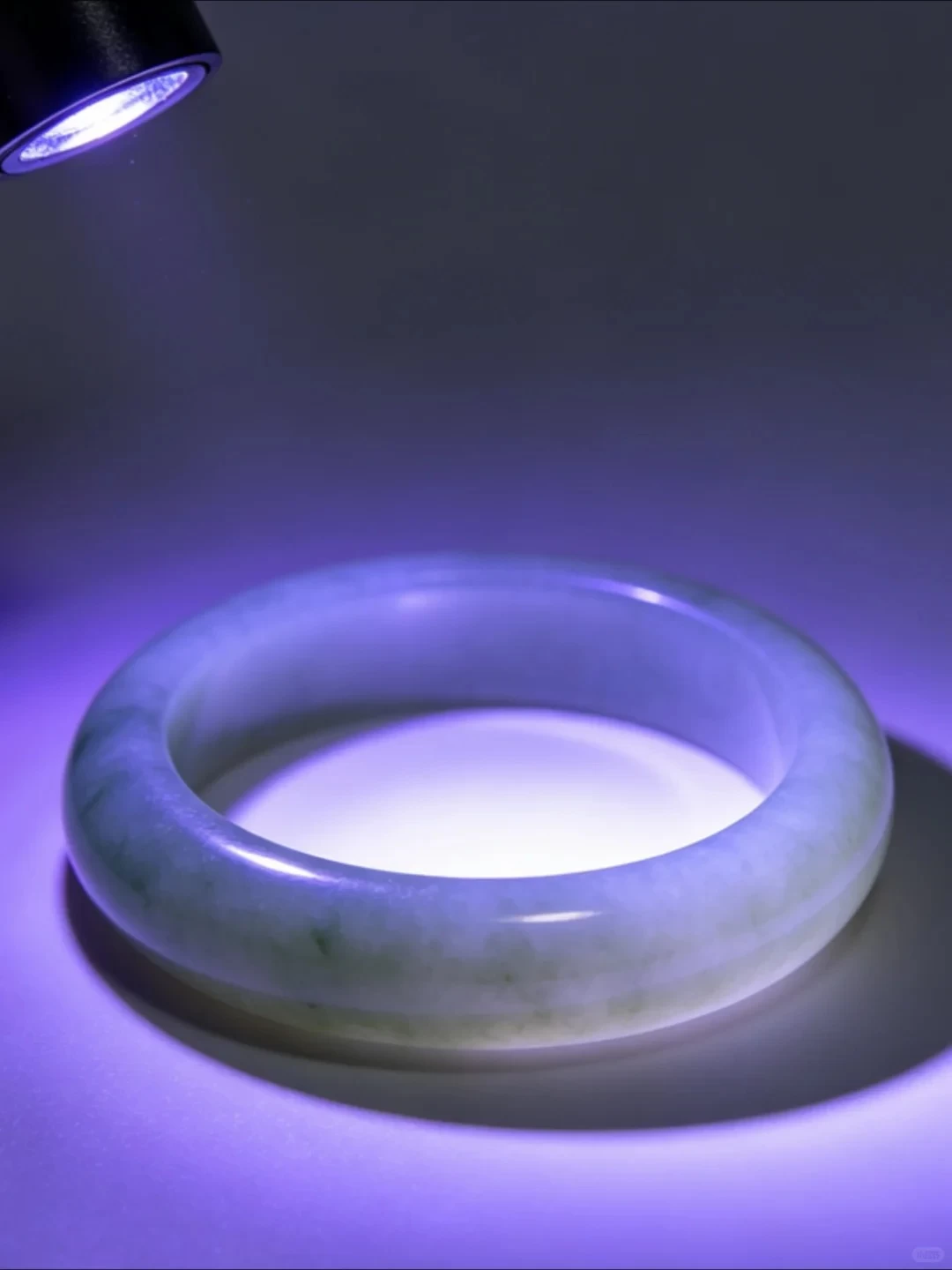
When jadeite undergoes acid washing and resin impregnation, the filling resin may exhibit bluish-white fluorescence under ultraviolet illumination. This reaction is often more noticeable in cracks, grain boundaries and internal gaps.
Natural untreated Type A jadeite generally shows no fluorescence or only a weak reaction under long-wave UV light. However, some natural lavender jadeite may also fluoresce. Therefore, UV fluorescence should be used as a preliminary reference and combined with other gemological testing methods for a reliable conclusion.
3. Key Advantages of LIGHTFE Gemstone Inspection UV Flashlights
LIGHTFE gemstone inspection flashlights use high-power 365 nm UV LEDs combined with professional UV-transmitting filters and optical convex glass lenses. They deliver an even beam without obvious dark areas, helping users observe fluorescence colors more accurately.
The product range includes several models:
- UV301D Plus: Powered by two AA batteries, offering approximately 2.5 hours of runtime in high-output mode and weighing only 73 g.
- ZM28WD Adjustable-Focus Dual-Light Flashlight: Combines white light and UV light in one device, with an adjustable-focus function for different inspection requirements.
LIGHTFE UV flashlights are widely used for inspecting minerals, amber and beeswax amber, as well as checking anti-counterfeiting features on banknotes, documents, paintings and collectibles. Their lightweight bodies are made from aerospace-grade aluminum alloy and feature anti-roll texturing for comfortable, extended handheld use.
They are practical inspection tools for gemological laboratories, jewelry professionals and collectible enthusiasts.
Selection Recommendation
For gemstone inspection, choose a professional LIGHTFE flashlight featuring a 365 nm wavelength, a high-quality UV filter, uniform beam distribution and minimal visible-light leakage.
The LIGHTFE ZM28WD adjustable-focus dual-light flashlight allows users to switch freely between white light and UV light, providing two inspection functions in one portable device.
Important: UV fluorescence alone cannot conclusively determine whether a gemstone or collectible is genuine. Results should be evaluated together with professional instruments and other identification methods.