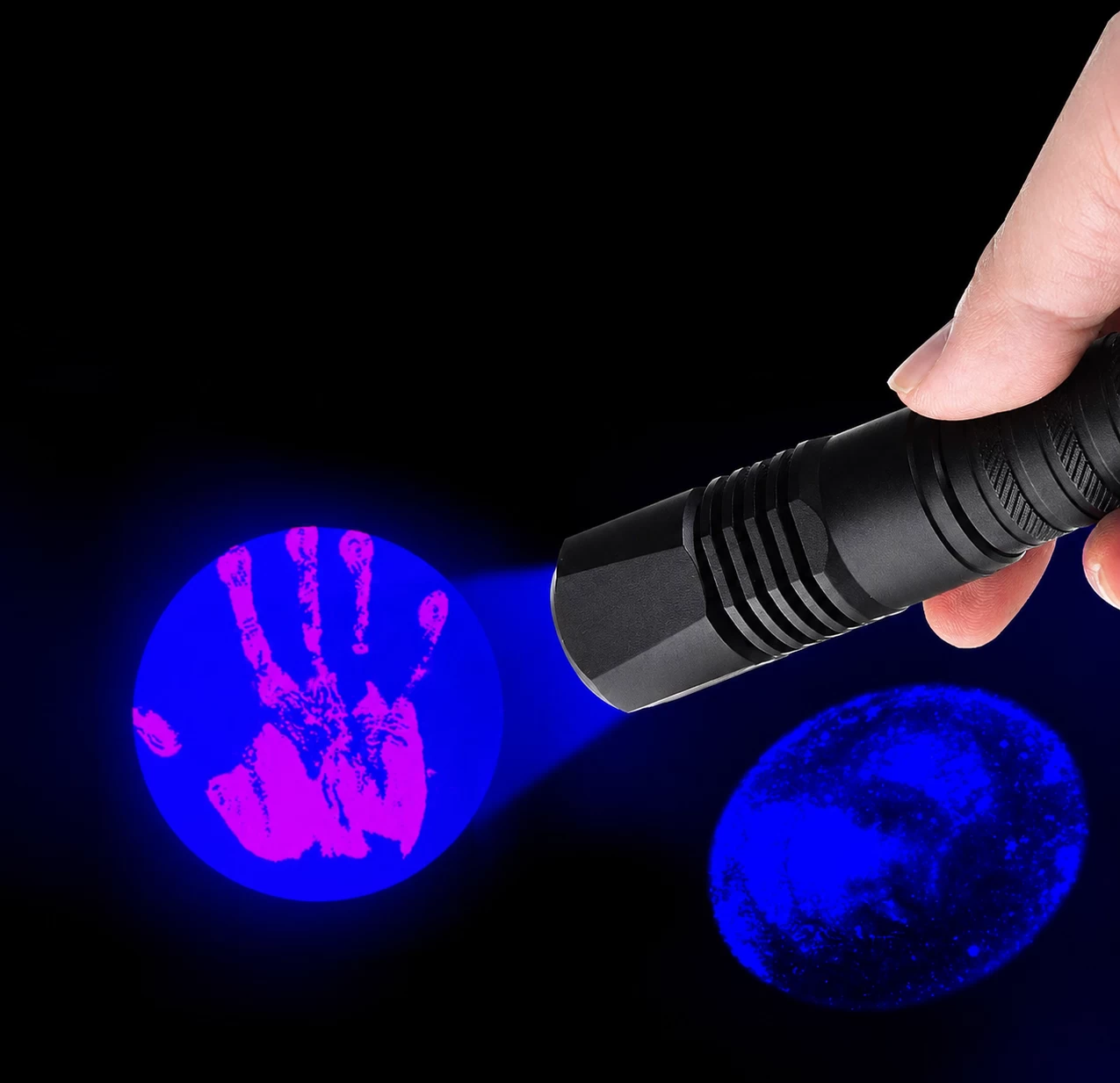
In criminal investigations, locating and collecting trace evidence can play an important role in reconstructing events. A forensic UV flashlight uses ultraviolet excitation to reveal certain biological residues, treated fingerprints, fibers and chemical traces that may be difficult to detect under ordinary visible light.
1. Locating Latent Fingerprints
Human perspiration and skin secretions contain amino acids, salts, oils and other substances. When a person touches an object, these materials may leave fingerprint patterns that are invisible to the naked eye.
Some residues may respond under ultraviolet illumination, while others must first be treated with fluorescent powders or chemical reagents. The appropriate development method depends on the surface:
Smooth, nonporous surfaces—glass, metal and plastic:
Fluorescent fingerprint powder can adhere to residues along the friction ridges. Under suitable UV or alternate light, the treated pattern produces strong contrast against the background.
Porous surfaces—paper and unfinished wood:
Chemical developers such as ninhydrin, DFO or 1,2-indanedione may be used to react with amino acids. The exact reagent and illumination method must be selected according to professional forensic procedures.
Rough or textured surfaces:
Specialized lifting materials, fluorescent dyes or other surface-specific development techniques may help investigators locate and recover fingerprint evidence.
2. Screening for Biological Fluid Stains
Certain biological fluids may produce fluorescence or visual contrast when illuminated with UV or alternate light sources.
Semen stains:
Some stains may appear bluish-white under 365 nm UV illumination, helping investigators identify areas for further testing in sexual-assault investigations.
Saliva:
Saliva stains may produce weak fluorescence under certain wavelengths, although visibility depends on the surface, concentration and environmental conditions.
Urine:
Urine residues may fluoresce under UV light, but their appearance can vary considerably. Chemical testing may be required for more reliable detection.
Blood:
Blood does not normally produce strong fluorescence. It often absorbs UV or alternate light and may appear darker than the surrounding surface. This contrast can help locate possible stains, including diluted or partially cleaned residues.
UV observations are presumptive only. Any suspected biological stain must be documented, collected and confirmed using validated laboratory tests.
3. Examining Fibers and Other Trace Evidence
Textile fibers, carpet fibers and some types of hair may differ in fluorescence color and intensity under UV illumination. These differences can help investigators locate and compare trace materials.
Fiber fluorescence may vary according to:
- Fiber composition
- Dyes and optical brighteners
- Chemical treatments
- Aging and environmental exposure
- Manufacturing processes
Fluorescence is generally used as a screening or comparison characteristic rather than conclusive proof that two fibers share the same source.
4. Key Advantages of LIGHTFE Forensic UV Flashlights
LIGHTFE forensic inspection flashlights combine high-power UV LEDs with specialized optical lenses. A wide, uniform beam supports rapid searches across larger areas, while a focused beam can assist with closer examination of specific locations.
Key features include:
- High-power UV LED illumination
- Wide-angle, uniform beam coverage
- Optional focused illumination for detailed inspection
- IPX8 water resistance, tested at depths of up to 2 meters
- Impact resistance from heights of up to 1.5 meters
- Corrosion-resistant aerospace-grade aluminum body
- Type III hard-anodized surface treatment
- Rechargeable 18650 lithium-ion battery
- Runtime of approximately 2.5 hours or longer
- Multiple output levels on selected models
These features help the flashlight perform reliably in demanding crime-scene and field-inspection environments.
Beyond forensic work, LIGHTFE UV flashlights can also be used for detecting pet urine and stains, locating scorpions and certain insects, inspecting hotel-room cleanliness, examining cracks or repairs in ceramics and antiques, and finding automotive fluid leaks when compatible fluorescent dyes are present.
Selection Recommendation
For forensic scene searches, consider a high-power LIGHTFE 365 nm UV flashlight with a wide, uniform beam for scanning large areas and a focused mode for detailed observation. Compatible orange protective glasses may improve visual contrast under certain conditions.
A UV flashlight is a screening and locating tool—not a standalone identification method. All suspected evidence should be handled by trained personnel and confirmed through approved forensic procedures.